- Built
- c. 1774
- Style
- High Georgian Georgian
- Neighborhood
- High Street District
- MACRIS
- NWB.40 ↗
History
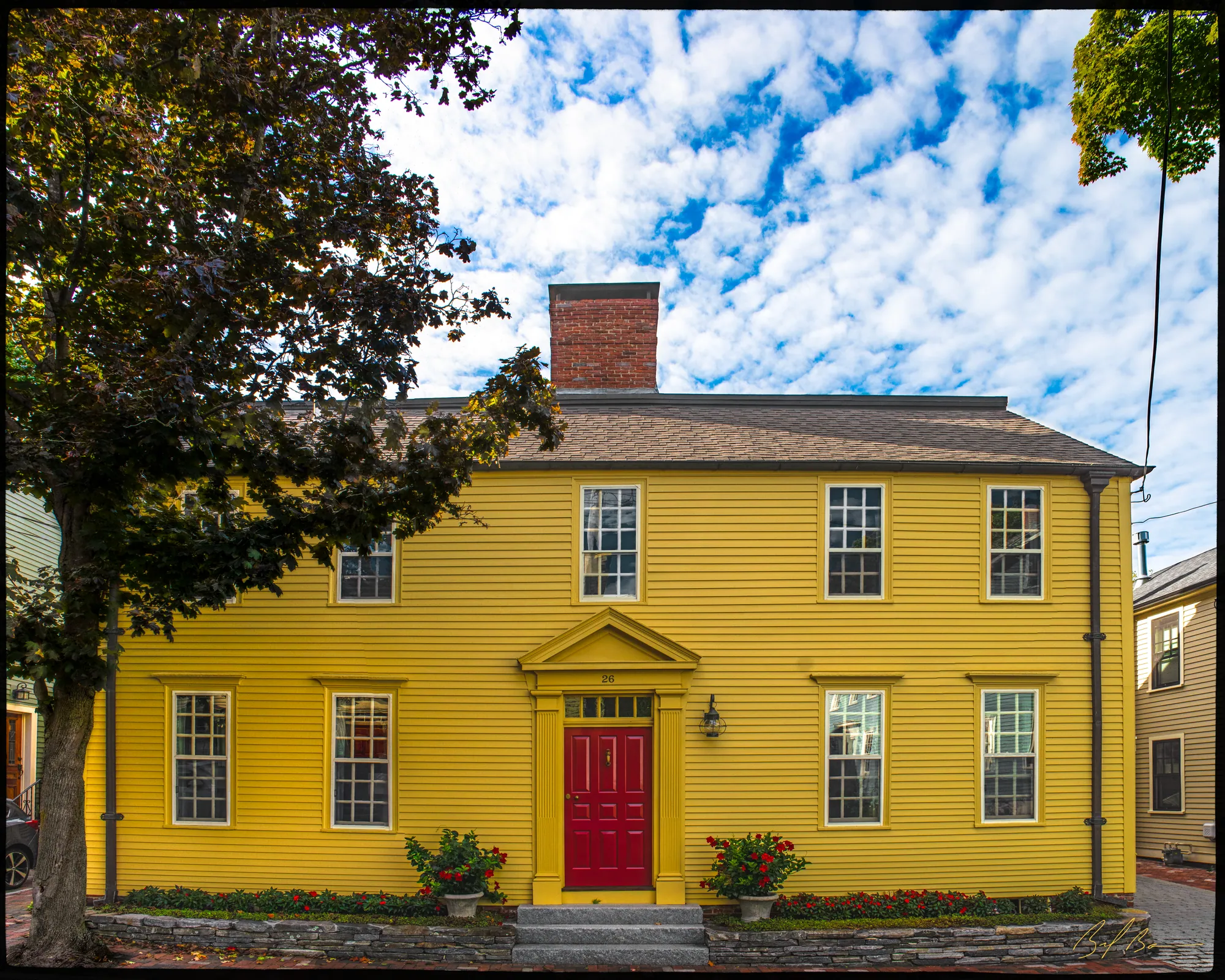
This house is one of the finest homes on High Street. Although built during the Georgian period, the house has features of the Federal style that was to become so popular in Newburyport during the following decades. The house is three stories in height with a hipped roof and smaller windows on the third floor.
The modillioned cornice is exceptional. The window lintels are unlike those on High Street. They are almost arched, adding an interesting element to the building’s facade. The entrance portico is pedimented, and the entablature is supported by fluted Ionic columns. The door itself is flanked by Ionic pilasters. It also has a simple semi-circular fanlight.
The Lowell Johnson house was built about 1774 by John Lowell, a counsellor-at-law. He and Jonathan Jackson purchased five acres of land on High Street in 1771. Lowell built this house shortly thereafter, while Johnson built what would later be known as the Timothy Dexter House next door.
When Lowell moved to Boston, the parcel of land was partitioned between Lowell and Jackson. Lowell sold his part of the land with a dwelling house to Patrick Tracy.
Patrick Tracy owned this house for many years. The house was occupied by his son John, an enthusiastic supporter of the colonial government during the Revolution, who served as an aide-de-camp to General Glover in Rhode Island under General Sullivan. Tracy entertained the Marquis de Chastellux in this house in 1782. After the war, Tracy’s business was less prosperous, and he and his children, having inherited the house from Patrick Tracy, sold the house to Eleazer Johnson in several parcels about 1810.
Eleazer Johnson was born in 1773. He was engaged in commercial pursuits and, at one time, was the president of the Mechanics’ Bank in Newburyport. He died in 1847, leaving the house to his only son, Richard. The house belonged to Richard and his heirs until the late 20th century.
Planning work on this building?
Reviews that may apply
Newburyport Historic District (National Register, listed 1984) · Demolition Control Overlay District (DCOD) · Parcel 37-11 · Zone HSRB
Zoning Board of Appeals may decide
In the DCOD. Whether removing more than 25% of the exterior walls needs a DCOD special permit depends on the building’s status in the 1984 National Register nomination, which this site has not matched for this lot yet; the Office of Planning and Development keeps the list.
Newburyport Historical Commission decides whether to impose a delay
Built c. 1774, so 75 or more years old: removing more than 25% of its exterior walls, changing the roofline (pitch, towers, cupolas, anything projecting above the roof), moving it, or adding a dormer that misses the setback and pitch rules is "demolition" under the demolition delay ordinance. The Commission holds a hearing within 30 days and may impose a delay of up to 18 months. Parts of the building documented as younger than 75 years are excluded on a written determination by the Zoning Administrator.
Code of Ordinances ch. 5 art. X, §§5-307–5-308 (June 2026) ↗
Zoning Administrator first stop
Every project starts with a zoning determination from the Zoning Administrator, which says which of these reviews apply and whether the work also needs zoning relief (a special permit for a non-conformity, or a variance). Fees, forms and filing deadlines are on the City’s site.
Not legal advice, not an official City publication, and not the position of the Historical Commission or any board. Says what the ordinances say as of September 30, 2026; the Zoning Administrator decides what applies. Boundaries: Merrimack Valley Planning Commission / City of Newburyport GIS (MIMAP); 1984 status from the National Register nomination's district data sheets. City's quick guide to the DCOD and demolition delay ↗ · Do I need approval? Project by project →
More photos
2 views · Biff Bouse
From the archive
2 items · maps, papers, old photographs
More built Before 1775
Sources
- Massachusetts Cultural Resource Information System, NWB.40