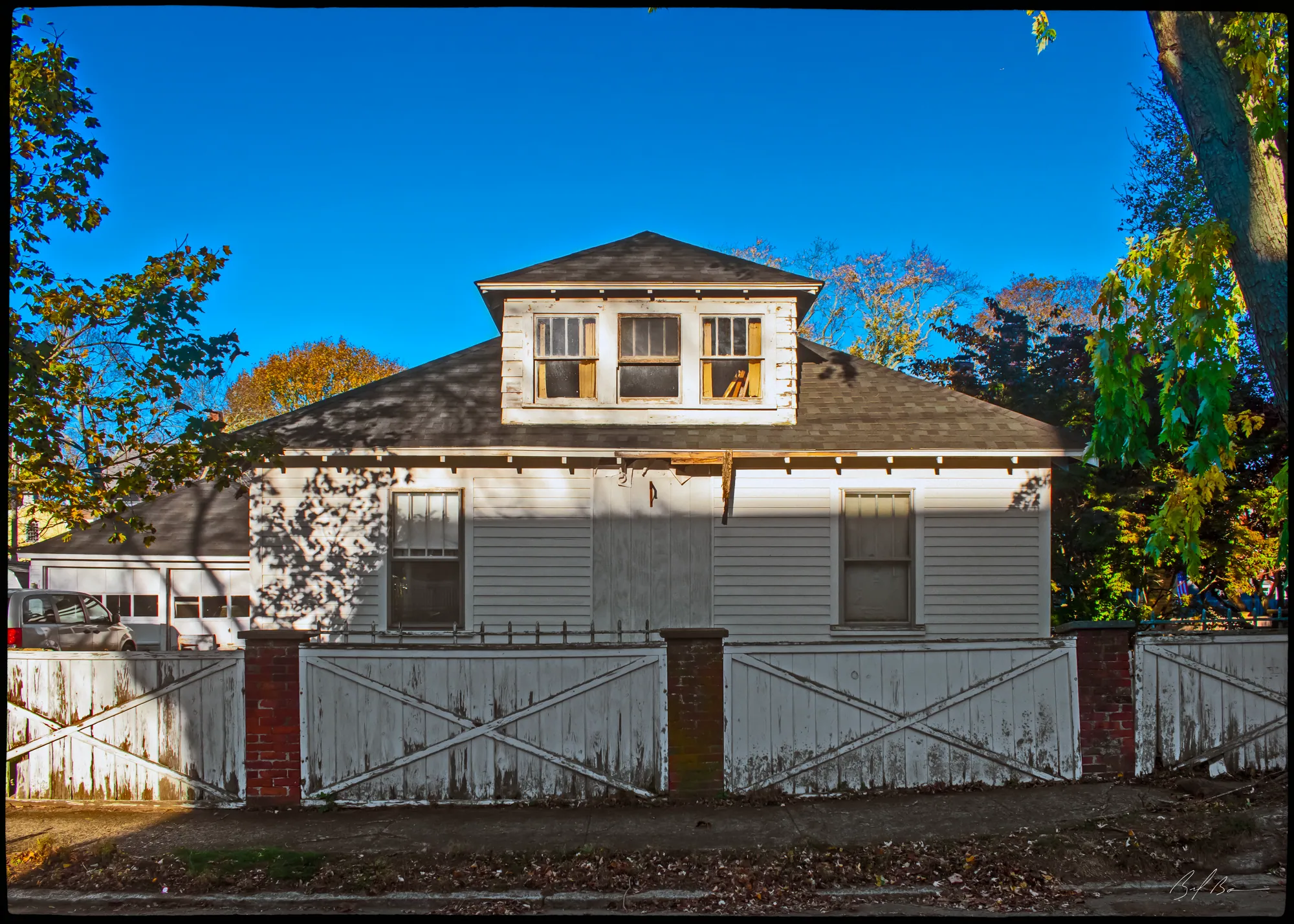
Congress Street · No. 8 · NWB.1268
8 Congress Street
Charles B. Brown House
- Built
- c. 1941
- Style
- Craftsman
- MACRIS
- NWB.1268 ↗
History
The structure is a 1½-story wood-frame bungalow, built in a vernacular Craftsman style. It features a low-pitched, hipped roof with wide overhanging eaves and exposed rafter tails. A centered hipped dormer projects from the roofline, containing paired double-hung sash windows with simple wooden surrounds.
Overall, the building is a compact, utilitarian example of a 1940s New England bungalow, characterized by its simple proportions, practical design, and restrained ornamentation.
The building on Congress Street was initially constructed in 1812 as the Newburyport Baptist Church, replacing the congregation’s first meetinghouse, which was destroyed in the Great Fire of 1811. The land was purchased from Thomas Merrill, and the church served the Baptist community until 1869, when it merged with the Green Street Baptist Church to form the Central Baptist Society of Newburyport. In 1877, the First Baptist Society sold the property to Daniel Pike, with the deed stipulating that the bell remain in the tower as long as the building was used for worship. Three years later, in 1880, Pike sold the church to Orin J. Gurney, a former mayor of Newburyport. The bell was later sold to the city and used on a fire engine house before being presented to Oak Hill Cemetery in 1895.
Rather than demolish the structure, Gurney converted the church into a box factory, preserving its sturdy timber frame and well-built steeple. For about thirty years, “Gurney’s Box Factory” operated within the former church, which was noted for its exceptional structural soundness and adaptability to industrial use.
In 1915, a fire severely damaged the building, destroying the tower, which was replaced with a flat roof. Gurney sold the property in 1922 to the Pearl Shoe Company, which operated there until going bankrupt in 1935. The structure was subsequently demolished, and in 1940, the Institution for Savings sold the land to Charles B. Brown, who built the bungalow that stands on the site today, likely completed in 1941.
More built 1900–1945
Sources
- (s):
- Massachusetts Cultural Resource Information System - NWB.1268