- Built
- c. 1800
- Style
- Federal Federal
- Neighborhood
- Joppa District
- MACRIS
- NWB.176 ↗
History
This week, I’m focusing on Newburyport’s “Joppa Historic District”. The area extending from South Street, now Bromfield Street, to Rolfe’s Lane, now Ocean Avenue, was settled by fishermen. It was and continues to be known as Joppa.
The homes in Joppa are, for the most part, modest eighteenth-century, single-family dwellings. Several of the houses along Water Street are slightly more pretentious. Only occasionally does one find a Federal period dwelling in Joppa, generally on the district’s outskirts.
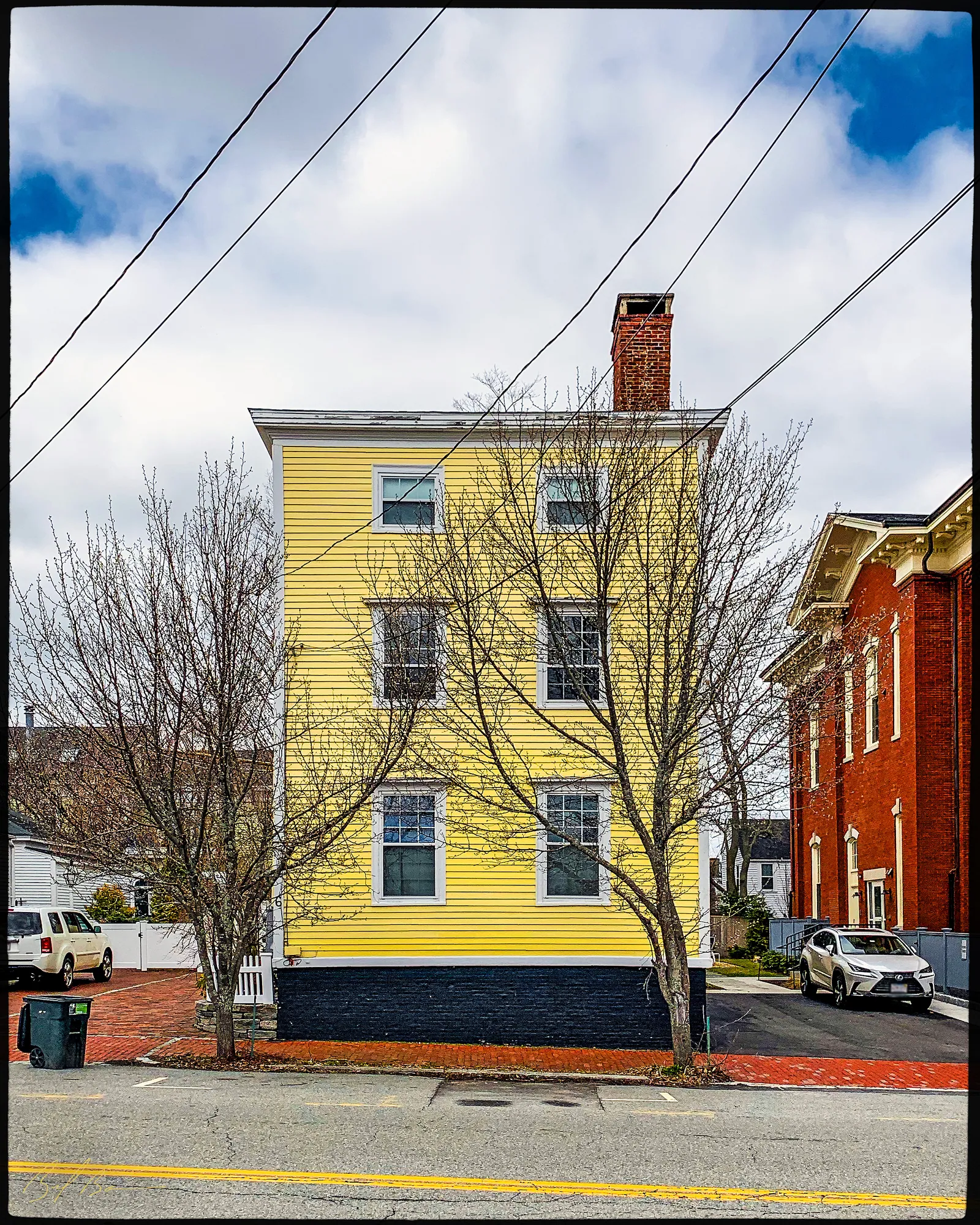
This home is an excellent example of the Federal style that predominated in Newburyport during the early years of the nineteenth century. The three-story house with a hipped roof and decreasing window size in the upper floors is typically Federal. The front entrance is reminiscent of earlier Georgian doorways. It resembles a classical temple in miniature. It is pedimented, and the door is flanked by Doric pilasters. It lacks the fanlight so often seen in Federal architecture.
This house was probably built around the turn of the nineteenth century. The earliest owner has yet to be documented but was perhaps associated with the maritime interests on the banks of the Merrimack River.
In 1872, this house was owned by George Donnell and Alfred Hale. Hale was an expressman.
By 1884, the property was conveyed to Charles C. Donnell and others. In 1912, Benjamin P. Donnell, Charles C. Donnell’s estate administrator, sold the property to Carl Knight. The house remained in the Knight family until 1930.
Planning work on this building?
Reviews that may apply
Newburyport Historic District (National Register, listed 1984), contributing in the 1984 nomination · Demolition Control Overlay District (DCOD) · Parcel 29-43 · Zone R2
Zoning Board of Appeals decides
Listed as contributing in 1984, so removing more than 25% of its exterior walls, counted cumulatively since 2014 and including walls enclosed by an addition or openings filled in, needs a DCOD special permit; the Board may grant one only if the building retains no substantial remaining market value or reasonable use. The Historical Commission sends an advisory report. Replacing siding, or windows and doors in their openings, does not count.
Newburyport Historical Commission decides whether to impose a delay
Built c. 1800, so 75 or more years old: removing more than 25% of its exterior walls, changing the roofline (pitch, towers, cupolas, anything projecting above the roof), moving it, or adding a dormer that misses the setback and pitch rules is "demolition" under the demolition delay ordinance. The Commission holds a hearing within 30 days and may impose a delay of up to 18 months. In the DCOD the wall test goes to the Zoning Board instead; the Commission keeps roofline, roof pitch and dormer work. Parts of the building documented as younger than 75 years are excluded on a written determination by the Zoning Administrator.
Code of Ordinances ch. 5 art. X, §§5-307–5-308 (June 2026) ↗
Zoning Administrator first stop
Every project starts with a zoning determination from the Zoning Administrator, which says which of these reviews apply and whether the work also needs zoning relief (a special permit for a non-conformity, or a variance). Fees, forms and filing deadlines are on the City’s site.
Not legal advice, not an official City publication, and not the position of the Historical Commission or any board. Says what the ordinances say as of September 30, 2026; the Zoning Administrator decides what applies. Boundaries: Merrimack Valley Planning Commission / City of Newburyport GIS (MIMAP); 1984 status from the National Register nomination's district data sheets. City's quick guide to the DCOD and demolition delay ↗ · Do I need approval? Project by project →
More built 1775–1830
Sources
- Massachusetts Cultural Resource Information System - NWB.176