Walking tours · History · 12 stops
Newburyport in the Civil War
A loop through the centre of town, from the Grand Army building on State Street up to Caleb Cushing's house on High Street and back by Federal Street, the waterfront and Market Square, following the city through the war of 1861 to 1865: the company that left in the sleet the day after Lincoln's call, the men who did not come back from Antietam, the Underground Railroad station on Federal Street, the birthplace of the abolitionist who came home in triumph in 1865, and the church where the city mourned the president. About a mile and three quarters.
- Length
- About 1.7 mi, a loop
- Time
- About 65 min, with the reading
- Start and finish
- 57 State Street, the Grand Army Building
Before you set off
John J. Currier's History of Newburyport, published in 1906, tells the beginning in a few lines. Fort Sumter fell on April 14, 1861; the president called for seventy-five thousand volunteers the next day; the Eighth Regiment of Massachusetts militia was ordered to the defence of the capital, and the city council voted a thousand dollars for the wives and children of the men who went. On the sixteenth, Currier says, “while rain and sleet were falling fast, the first detachment of the Cushing Guards, consisting of twenty members of company A of the Eighth regiment, left Newburyport for Boston, under the command of Capt. Albert W. Bartlett.” Seventy more joined them at Faneuil Hall two days later. By the end, Currier counts fifteen hundred and eleven men enlisted in Newburyport between April 1861 and April 1865, two hundred and eighteen more than the city was asked for, with two hundred more officers and seamen for the navy's gunboats, and nearly a hundred and twenty-five thousand dollars raised to pay for it all.
Hurd's History of Essex County, published in 1888, fills in the companies: the McClellan Guard under Captain Luther Dame, which went into the Eleventh Regiment in June 1861 and fought in twenty-four battles; Company B of the Thirty-fifth, raised by the same Captain Bartlett in August 1862 and at Antietam within a month; Company A of the Forty-eighth under Colonel Eben F. Stone of this city, nine months at Port Hudson. Hurd prints the names of the dead, from Captain Bartlett down, and counts the city's war debt at a hundred and twenty-three thousand dollars, “and no man murmured at the increased taxation which it involved.” Most of the war's Newburyport happened in rooms and streets that are still here, and this walk goes to them.
Numbers follow the walk. The line is the route along the streets, back to where you started.
Read it aloud as you go: each stop begins with where to walk and where to stand, then what the old histories say about the place. The sources are named as you read and listed in full at the end.
StartThe loop begins at 57 State Street, the three-storey brick building on the east side of State Street, two blocks up from Market Square, across from the foot of Pleasant Street. There is public parking in the lots off Inn Street and Green Street. Stand on the opposite pavement so you can see the whole front, then cross to read the bronze plaque between the two ground-floor windows. look: The plaque of 1924 between the windows; above it, the building the Grand Army of the Republic owned for most of a century.
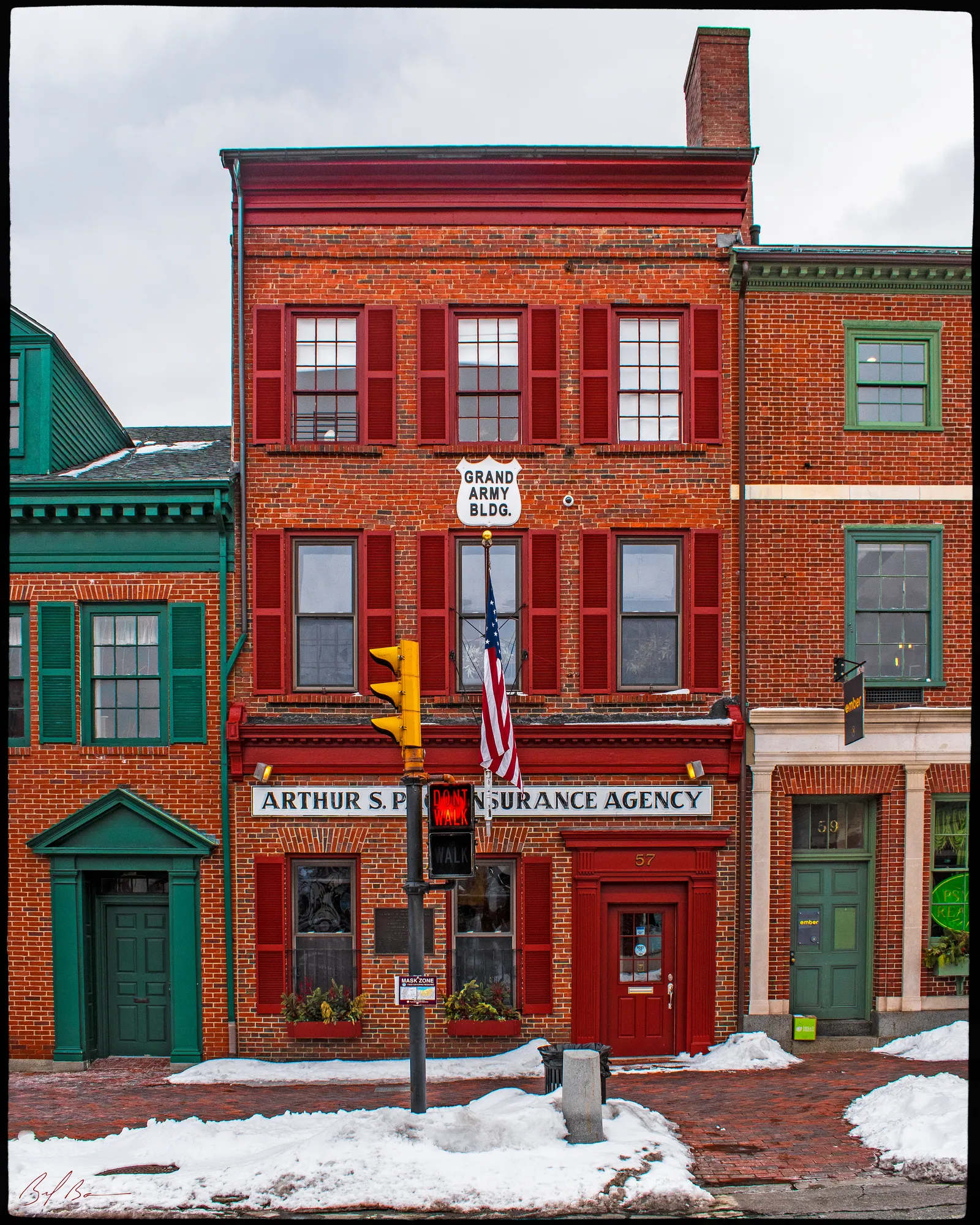
The front, the state's historic inventory form says, is a remodelling of 1960; old photographs show an Italianate block with a central doorway and shop windows. The form, citing the local historian Dr. Ron Irving, dates it to 1853, built by William J. Hodge for Amos Tappan, with a hardware store on the lower floors and Company A, the Cushing Guard, drilling on the top one. Hurd's History of Essex County of 1888 says the company dated from 1775 as the Newburyport Artillery Company and took the name Cushing Guard in 1852 for Caleb Cushing, the city's first mayor. Hurd tells what happened on Monday, April 15, 1861. Captain Albert W. Bartlett got his orders by telegraph at half past three in the afternoon and, “at once ordering his carriage, served before dark a summons upon his entire command to meet that evening in the armory.” Currier's History of 1906 has twenty men leaving in the sleet the next day and reaching Washington on the twenty-sixth, having repaired a railroad on the way; Hurd adds the regiment's rescue of the frigate Constitution at Annapolis. The plaque says twenty-four officers and men marched from this building; the inventory form is honest that nobody has proved they left from here.
Bartlett did not survive the war: Hurd lists him first among the city's dead, killed at Antietam on September 17, 1862, commanding the company he had raised for the Thirty-fifth that August. Hurd says the city's post of the Grand Army of the Republic was named in his honor, and the inventory form records that the post, organized in 1868, bought this building on March 9, 1877, for eighty-three hundred dollars, kept its hall on the top floor into the twentieth century, and rented the shops below. A gale took the roof off in April 1882, and the walls were raised and the hall rebuilt and frescoed.
Sources: MACRIS inventory form · Hurd, History of Essex County, vol. 2 (1888) · Currier, History of Newburyport, vol. 1 (1906), pp. 670–671 · Currier, History of Newburyport, vol. 2 (1909), pp. 114–115
Walk · 260 yardsWalk up State Street, away from the river, about 135 yards to Prospect Street and turn left. About 125 yards along Prospect Street, the bank's parking lot is the site.
Stop 2 · Lost
Amos W. Lee house
There is no house here to look at. Our own research for this site places on this lot the Prospect Street home of Amos W. Lee of the Thirty-fifth Massachusetts, who was wounded at Antietam; the old histories do not mention him by name, and this is the one stop on the walk that rests on the site's research alone. What the histories do give is his regiment. Hurd's History of Essex County says Company B of the Thirty-fifth was raised here under Captain Albert W. Bartlett, mustered in on August 21, 1862, and in action at South Mountain and Antietam within a month, and went on through Fredericksburg, Knoxville, Spotsylvania, Cold Harbor and Petersburg to its muster-out in June 1865. Hurd's roll of the dead names the Newburyport men of that company killed at Antietam on September 17, 1862, beside their captain: David B. Hinkley, George W. Hodgdon, Jere Long, Caleb C. Pike and Alphonso P. Rood, with Andrew Nash killed at South Mountain three days before. The wounded, like Lee, came home to streets like this one.
Sources: oldnbpt.com research · Hurd, History of Essex County, vol. 2 (1888)
Walk · 140 yardsCarry on along Prospect Street about 140 yards to Fair Street. The church on the corner, with its entrance on Prospect Street, is the stop.
Stop 3
Prospect Street Church
This is the meeting house of the Fourth Religious Society, and it was the Reverend Charles W. Milton's church before it was anyone else's. Currier's History of 1906 says Milton, a London man educated for the ministry by Lady Huntington, preached so well as a supply at the Old South in the winter of 1791 that his followers were censured for meeting him in a private house; refused the town house, they met for a year at Anthony Morse's on Milk Street, and raised the frame of this building on June 11, 1793, sixty-seven feet by sixty, with two towers, the main entrance on Prospect Street and a door, since closed, on Temple Street. The society was incorporated on February 22, 1794. Our own research for this site adds that Frederick Douglass spoke here in September 1841, early in his life as a lecturer, when the building was still called the Temple Street church.
The war came into this room too. Currier says that on February 22, 1862, at Lincoln's suggestion, the city flew its flags and rang its bells for half an hour morning, noon and night, and that a public meeting was held in the Prospect Street meeting house, where the Reverend Samuel J. Spalding read Washington's farewell address, patriotic songs were sung, and there were “congratulatory speeches made on the capture of Fort Donelson by the Union forces under General Grant.” The minister here through the whole war was the Reverend Randolph Campbell, pastor from 1837 to 1877, and Currier has him offering the prayer at the city's memorial service for Lincoln in April 1865, which is at the last stop of this walk.
Sources: Currier, History of Newburyport, vol. 1 (1906), pp. 280–283, 425, 423 · oldnbpt.com research
Walk · 520 yardsContinue along Prospect Street about 255 yards to Federal Street and turn right, uphill, for about 220 yards to High Street. Turn left along High Street; about 45 yards on, the big square house set back behind its fence on your right, with the balustraded roof and the two-storey porch, is number 63. look: The Palladian window over the Ionic porch, and the roof balustrade; our research for this site notes the fence is of an unusual and original design.
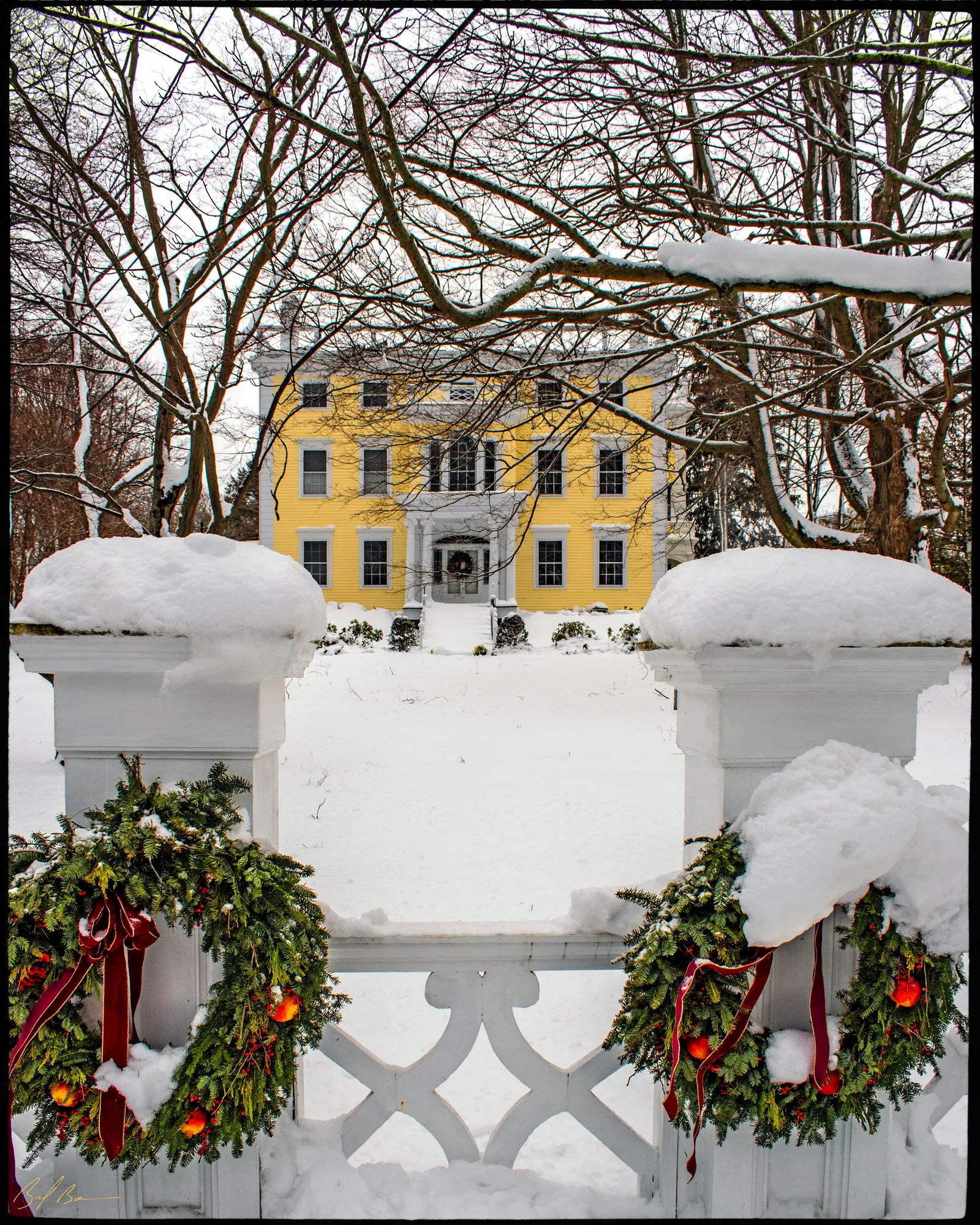
Currier's “Ould Newbury” of 1896 opens its chapter on Caleb Cushing with this house: “On the westerly side of High Street, a few rods below the head of Federal Street, stands the house that Caleb Cushing owned and occupied at the time of his death.” Richard Pike, a merchant and shipowner, built it at the beginning of the century on five acres bought from Woodbridge G. Hunt in January 1810 for five thousand dollars; Pike died in 1827, and Cushing bought the place from Solomon Haskell and the Pike heirs in April 1849. Cushing had by then been four times a congressman, minister to China, general of the only Massachusetts regiment in the Mexican War, the city's first mayor in 1851, and attorney general under President Pierce.
Then the war, and Currier does not soften it. In 1860 Cushing presided over the Democratic convention at Charleston and campaigned for Breckinridge; when the fighting began he offered his services “in any capacity, however humble,” and Governor Andrew, Currier says, “declined to appoint him to any position of influence in the State,” though Washington used him as an adviser on international law. “Ould Newbury” prints a photograph of this house taken in 1862 with Cushing and two friends at the gate, and says that “above the roof floats the flag that was daily displayed during the continuance of the war as a symbol of his loyalty and fidelity to the principles of constitutional government.” He sold this house to his brother William in 1868, argued the Alabama claims at Geneva, was nominated for chief justice by Grant and withdrawn, served as minister to Spain, and came back to this house, bought from William's estate, to die here on January 2, 1879. The state inventory form adds that William Cushing had been mayor in 1856 to 1858.
Sources: Currier, “Ould Newbury” (1896), ch. "Caleb Cushing" · MACRIS inventory form · Currier, History of Newburyport, vol. 1 (1906), p. 235
Walk · 100 yardsGo back along High Street about 45 yards to Federal Street and turn right, downhill. About 50 yards down, the low First Period house with the big central chimney is number 79. look: The steep roof and the massive chimney: the inventory form puts the house at about 1700, one of the oldest in the city.
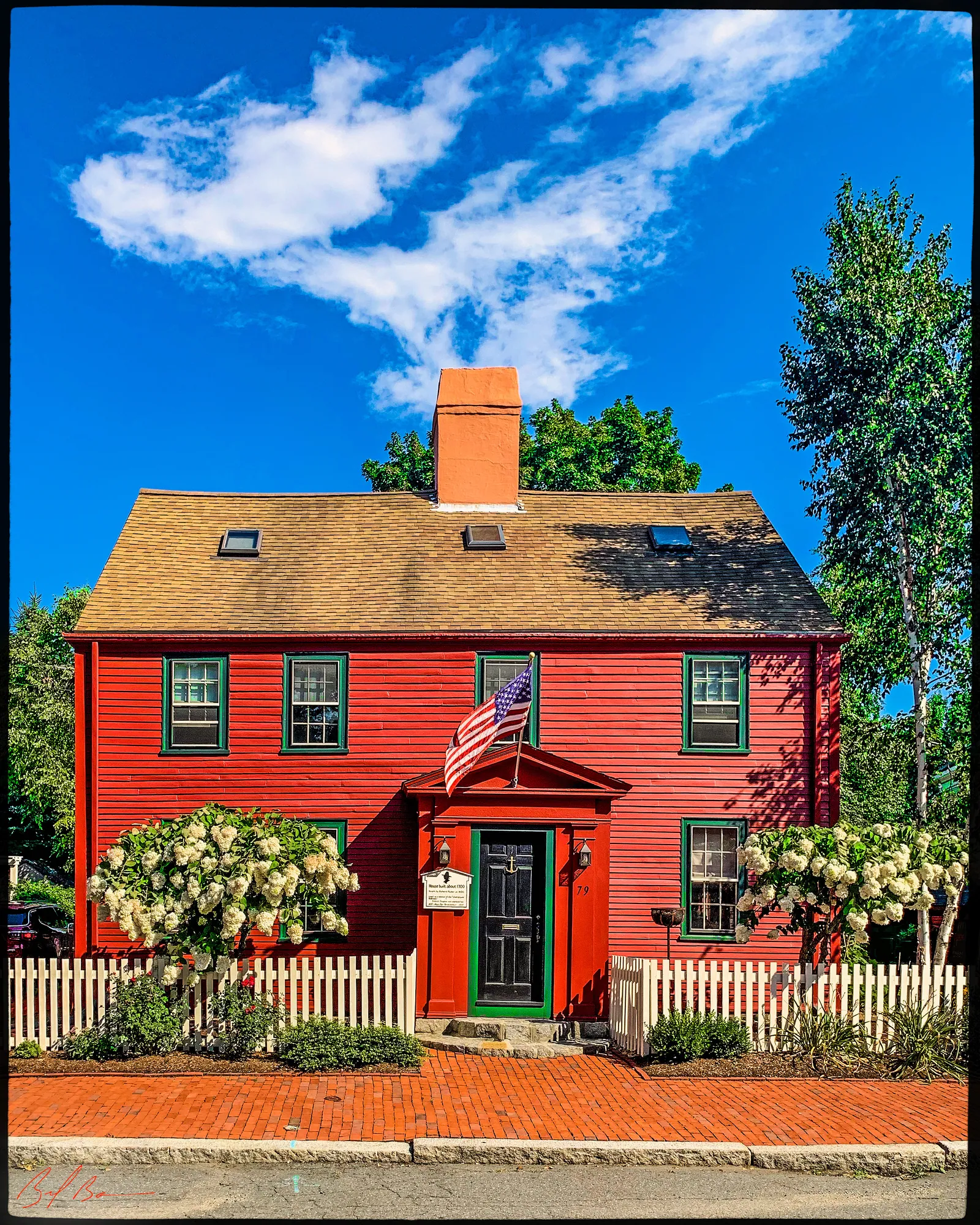
This is the Richard Plumer house, and its war story began before the war. The state's historic inventory form says Plumer, Captain Alexander Graves and William Jackman were the Underground Railroad in Newburyport: fugitives brought up from Ipswich over the Parker River bridge were hidden in the barn that stood behind this house, and Plumer drove them at night, under the grain in his wagon, to Jackman's house near the Chain Bridge, from where they went on to Amesbury or as far as Lee, New Hampshire; sometimes he crossed the Merrimack himself and handed them to John Greenleaf Whittier or his agent. His young son Wendell Phillips Plumer rode with him. If the house seemed watched, the form says, he left his passengers at the Coffin House over the line in Newbury, which he also owned. The form also complains that the National Park Service tells this story under the address 62 Federal Street, on the wrong side and much further down. Currier's histories know Plumer as a solid citizen rather than a lawbreaker: one of the incorporators of the Five Cents Savings Bank in 1854, a state senator in the late 1860s, and postmaster of Newburyport from 1869 to 1877. The barn is gone.
Sources: MACRIS inventory form · Currier, History of Newburyport, vol. 2 (1909), pp. 169, 492 · Currier, History of Newburyport, vol. 1 (1906), p. 385
Walk · 320 yardsContinue down Federal Street about 275 yards to Milk Street and turn right. The double house about 45 yards along is numbers 5 and 7.
Stop 6 · c. 1880
5–7 Milk Street
The state inventory record is all we have on this one: a two-family house of about 1880, in the mixed Victorian manner, put up fifteen years after the war. Currier's History of 1906 says Milk Street itself was accepted by the town in 1802, from Federal Street to Lime Street. It had an earlier moment: Currier and Mrs. Emery both say the dissenters who became the Prospect Street church met for a year, in 1792, at Anthony Morse's house on this street.
Sources: MACRIS inventory form · Currier, History of Newburyport, vol. 1 (1906), p. 351 · Emery, Reminiscences of a Nonagenarian (1879)
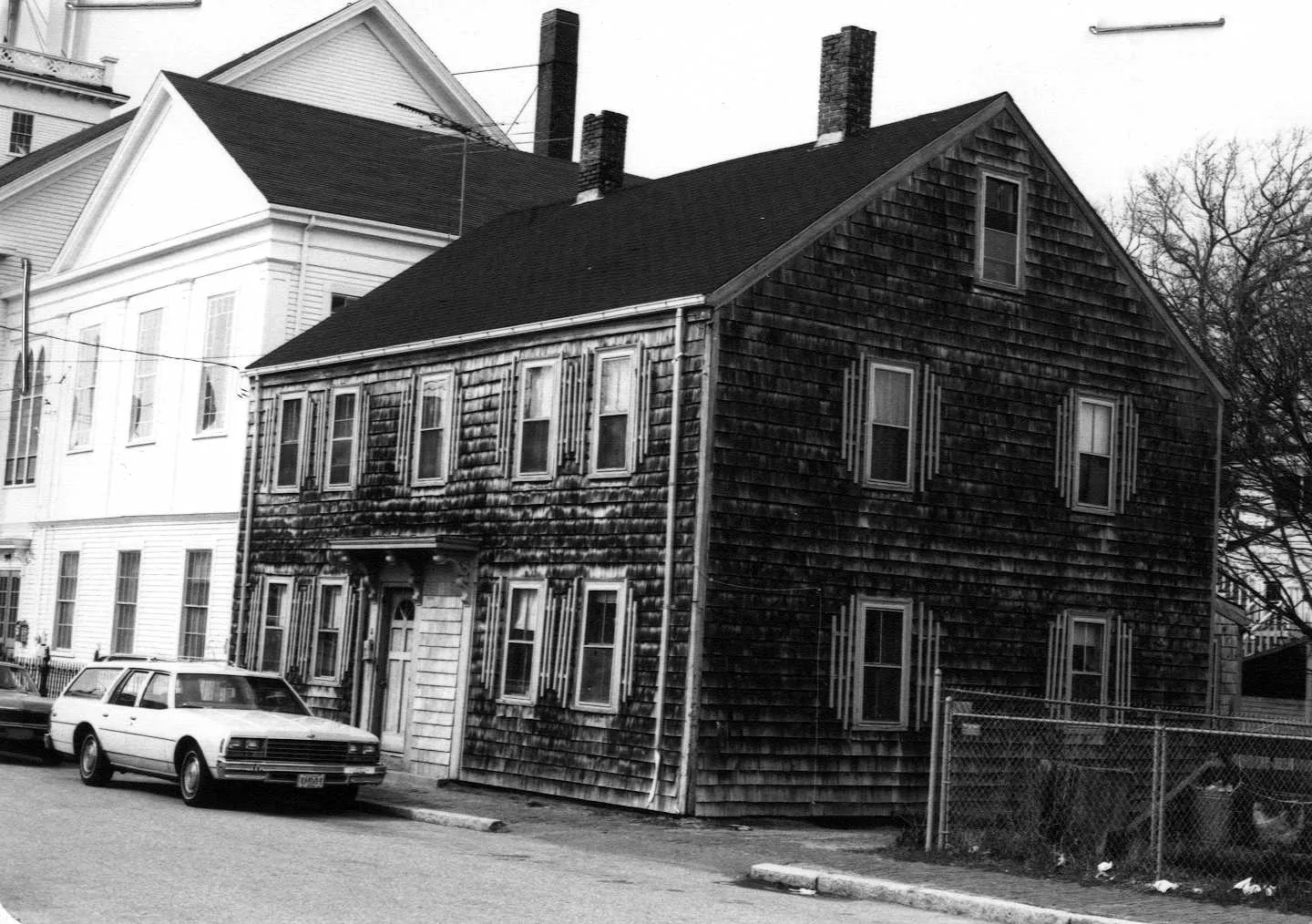
Walk · 230 yardsGo back to Federal Street and turn right, downhill, about 115 yards to School Street, the narrow street beside the Old South church; turn right into it. About 70 yards along, on your left, next to the church's vestry, is the small clapboard house, numbers 3 and 5.
Stop 7 · c. 1750
3–5 School Street
William Lloyd Garrison House
Photo: Massachusetts Historical Commission, MACRIS inventory
“In a house still standing on the easterly side of School Street, next to the meeting-house and vestry of the First Presbyterian Society of Newburyport, William Lloyd Garrison was born Dec. 10, 1805.” That is Currier's “Ould Newbury” of 1896, which says his parents, newly come from New Brunswick, hired a few rooms here from Captain David Farnham, a coasting skipper, and that the father walked out on the family within a few years. The boy lived with Deacon Ezekiel Bartlett at Merrimac and Summer Streets, was apprenticed at thirteen to Ephraim W. Allen of the Newburyport Herald, and in 1826 ran his own paper, the Free Press, from State Street, where in June 1826 he printed verses by Whittier at the very start of that poet's career. On September 28, 1830, Currier says, he spoke on slavery in the Titcomb Street meeting house and was to speak again the next night, “but, on account of the excitement created by his first address, the doors of the meeting-house were closed against him.” The Liberator began in Boston on January 1, 1831, with the line Currier quotes: “I am in earnest — I will not equivocate — I will not excuse — I will not retreat a single inch — and I will be heard.”
The war ending is the part that belongs to this tour. After the Thirteenth Amendment, Currier says, the citizens of Newburyport invited Garrison home to “receive the congratulations of his former townsmen on the triumphant culmination of his life-work,” and on February 22, 1865, he spoke to a City Hall filled to overflowing. The state inventory form dates the house to about 1750; the city put up his statue in Brown Square in 1893.
Sources: Currier, “Ould Newbury” (1896), ch. "William Lloyd Garrison" · Currier, History of Newburyport, vol. 1 (1906), p. 512 · MACRIS inventory form
Walk · 450 yardsReturn to Federal Street, turn right and walk the 260 yards down to the river, then turn left along Water Street. About 125 yards along, the two-storey brick building is number 65.
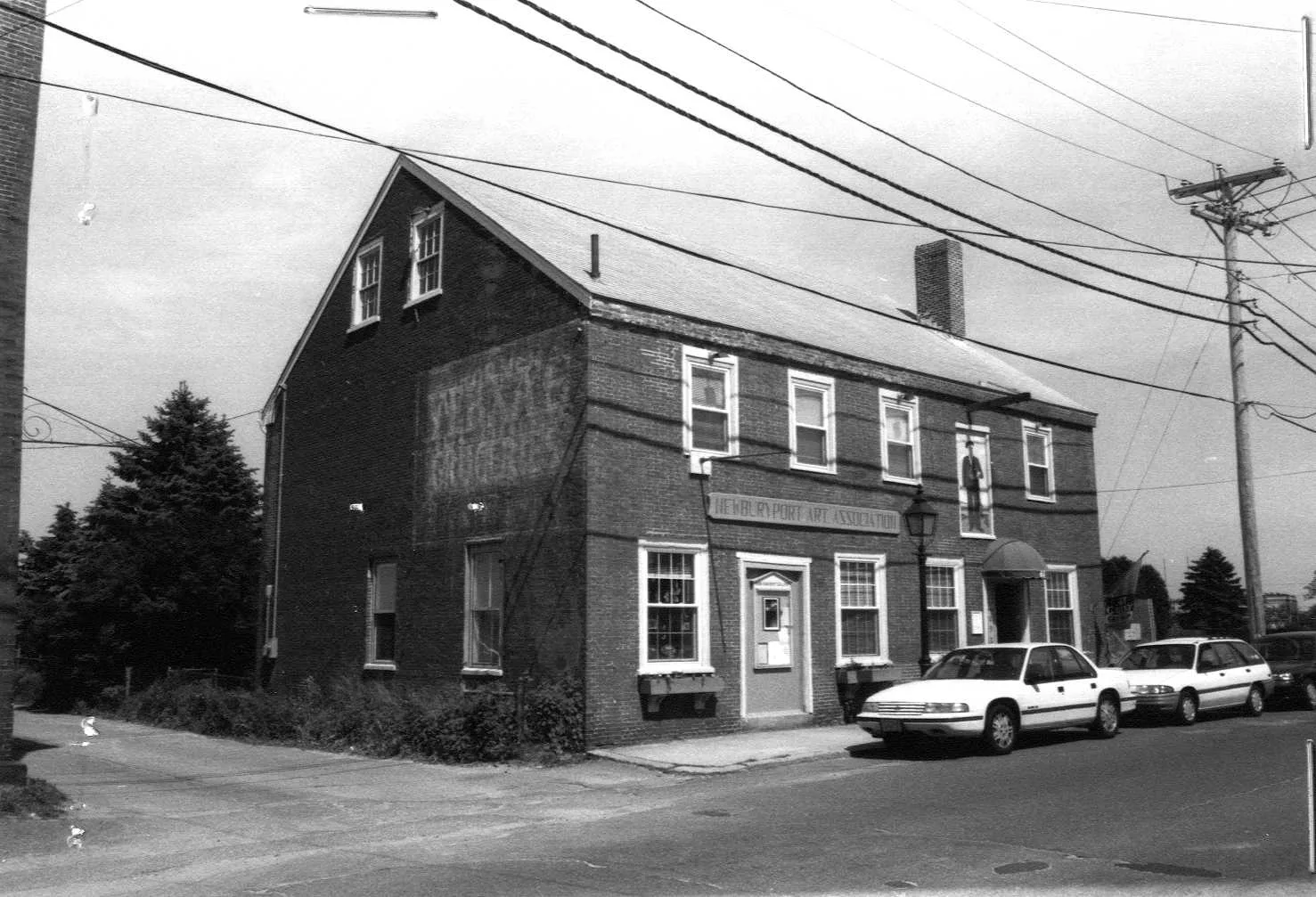
Stop 8 · 1815
65 Water Street
Capt. Anthony Gwynne Commercial Building
Photo: Massachusetts Historical Commission, MACRIS inventory
Our research for this site dates this plain brick commercial building to 1815, and it is the Newburyport Art Association now. It stands at the foot of Federal Street, which Currier's second volume says was Chandler's Lane when the merchant William Bartlet bought the flats at its foot in 1787 and built his wharves there. The reason to stop here is the river. Currier's History of 1906 says that besides its soldiers Newburyport “supplied the gunboats of the navy with two hundred officers and seamen,” and Hurd's History of Essex County counts two hundred and forty-two enlistments in the navy credited to the city, bringing its total of credits to fifteen hundred and eighty-five. Hurd's roll of the dead has the sailors too: John Devereux Jr. of the Colorado, dead at New Orleans in October 1862, and Dennis Leary of the Brooklyn, lost at sea the same year. The Custom House you will pass on the way to the next stop was the government on this waterfront; Currier's appendix lists Enoch G. Currier as collector of the port from 1861 to 1870. The inventory names the building for a Captain Anthony Gwynne; Currier knows an Anthony Gwyn who was dead before 1784, so the name may belong to an earlier owner of the land rather than the builder.
Sources: oldnbpt.com research · MACRIS inventory form · Currier, History of Newburyport, vol. 2 (1909), p. 234 · Currier, History of Newburyport, vol. 1 (1906), pp. 671, 676 · Hurd, History of Essex County, vol. 2 (1888)
Walk · 350 yardsWalk on along Water Street with the river on your right for about 310 yards, past the stone Custom House, and carry straight on into Market Square. Stand at the river end of the square, by the brick market house.
Stop 9
Market Square
Currier's “Ould Newbury” of 1896 says the great fire of 1811 “swept away most of the buildings then standing on the westerly and southerly sides of the Square,” and the brick blocks around you are what was built after it; the square was enlarged, Currier's History of 1906 says, when the old First Religious Society meeting house that stood in the middle of it came down in 1801 and the town paid forty-four hundred dollars toward the land. This is also the place to tell the one Newburyport story from the other side of the war. Albert Pike, the second volume of Currier's History says, was born in Boston in 1809, brought here in 1814, schooled in the town's primary and grammar schools, and in 1830 taught a private school in Newburyport, with an evening school in the lower storey of Washington Hall on Green Street; he walked most of the way to St. Louis and settled in Little Rock, where he edited a newspaper, read law and wrote poems. Mrs. E. Vale Smith's History of 1854 was proud of him: a captain of Arkansas cavalry at Buena Vista, mentioned three times in General Taylor's dispatches. Currier finishes it: “In the Civil war he was a brigadier-general in the Confederate army, and had command of several regiments, or battalions, of Cherokee Indians in the battles of Pea Ridge and Elkhorn.” Afterward he edited the Memphis Appeal, went to Washington in 1868, and became the head of Scottish Rite Masonry; he died there in 1891.
Sources: Currier, “Ould Newbury” (1896), ch. "Market Square" · Currier, History of Newburyport, vol. 1 (1906), pp. 255, 322 · Currier, History of Newburyport, vol. 2 (1909), pp. 321–322 · Smith, History of Newburyport (1854), p. 235
Walk · a few stepsNext door: the brick market house itself, at the river end of the square, with the clock on its front. look: The clock on the Market Square front; the 1896 replacement given by John T. Brown stands where the town's clock of 1837 was.
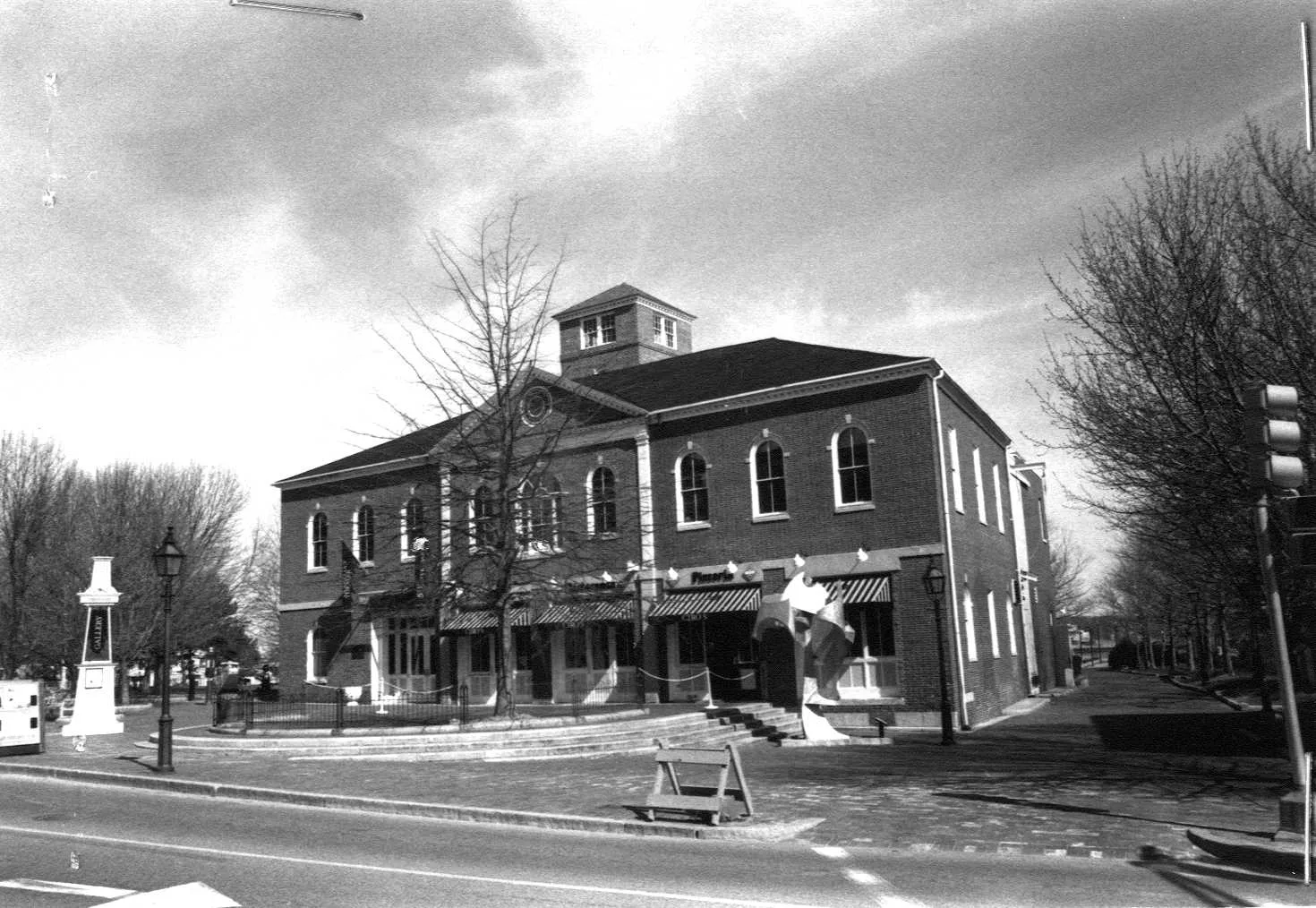
Stop 10 · c. 1825
1–3 Market Square
Old Market House (the Firehouse)
Photo: Massachusetts Historical Commission, MACRIS inventory
“The market-house, now the police-station and engine-house, was built in 1823, and occupies the space at one time known as the Middle Shipyard.” So says Currier's “Ould Newbury” in 1896, which traces the town's votes: brick, one storey, on the spot where the butchers' shambles stood, voted August 5, 1822, with a second storey added for a hall. Currier's History of 1906 says the first town meeting in the new hall was on March 23, 1835, with Caleb Cushing as moderator, and that for years the Lyceum lectures were given here. Market Hall had its own military moment before the Civil War: Mrs. Smith's History of 1854 says that when Cushing went off as colonel of the Massachusetts regiment for Mexico in 1847, the ladies of the town, having raised three hundred dollars for a present, were asked by him to spend it on his men's outfit and give him only a plain gold ring, which a young lady presented here on February 9 “with a brief address.” The war itself changed the ground floor. Currier's History says: “In 1864, the butchers' stalls on the lower floor were taken down and the space used for the accommodation of the new steam fire-engine, ‘Eon.’” It is the city's firehouse still; the state inventory form dates the building to about 1825.
Sources: Currier, “Ould Newbury” (1896), ch. "Market Square" · Currier, History of Newburyport, vol. 1 (1906), pp. 189–190 · Smith, History of Newburyport (1854), p. 235 · MACRIS inventory form
Walk · 180 yardsFrom the firehouse turn left for a few steps along Merrimac Street, then left again into Inn Street, the pedestrian mall; after about 45 yards bear left into State Street and walk up it, away from the river, about 115 yards. The Italianate block on your left on the corner of Essex Street, with the shops below and the hall above, is Essex Hall.
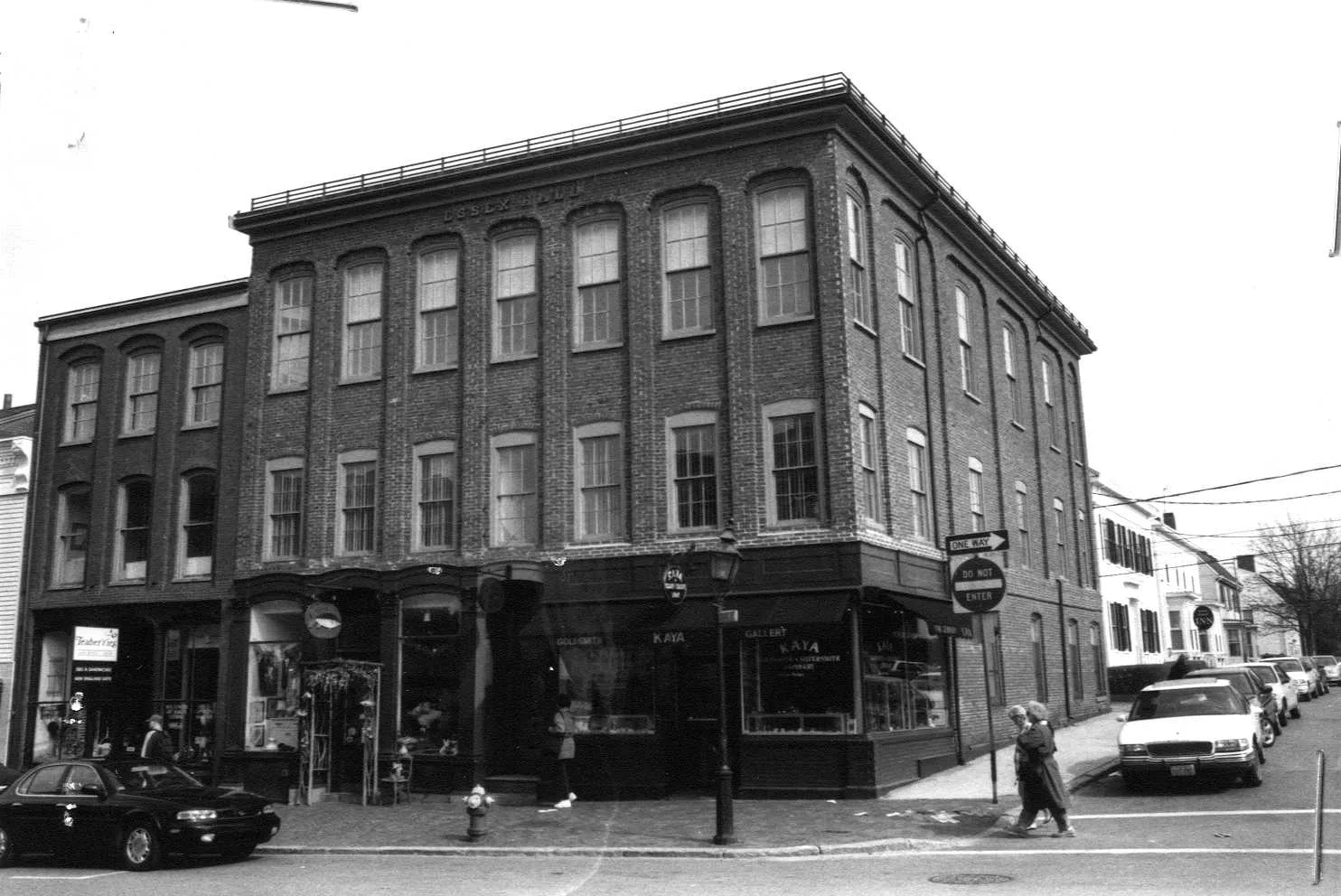
Stop 11 · c. 1855
35–41 State Street
Essex Hall
Photo: Massachusetts Historical Commission, MACRIS inventory
The state inventory form dates Essex Hall to about 1855, so it was new when the war came, and it has one direct link to the first stop: the inventory form for the Grand Army building says that before the war Albert W. Bartlett, the captain of the Cushing Guard, was connected with a dry-goods store at 37 State Street, in this block. The second volume of Currier's History places the building on the northeasterly corner of State and Essex Streets and follows its tenants: the young men's association that became the YMCA met in rooms under Essex Hall in the late 1870s, and the Five Cents Savings Bank moved into the Essex Hall building in 1904. “Ould Newbury” says the Masonic lodge room upstairs held the two twelve-foot portraits of Washington and General Joseph Warren that St. Mark's Lodge had commissioned in 1825 and 1826.
Sources: MACRIS inventory form · Currier, History of Newburyport, vol. 2 (1909), pp. 145, 172 · Currier, “Ould Newbury” (1896), ch. "Market Square"
Walk · 190 yardsCarry on up State Street about 55 yards and bear right into Pleasant Street. About 135 yards along, the white church with the tall spire is the First Religious Society's meeting house. Stand across the street to see the spire. look: The weathercock on the spire, a hundred and fifty-nine feet up, came from the old meeting house in Market Square in 1801.
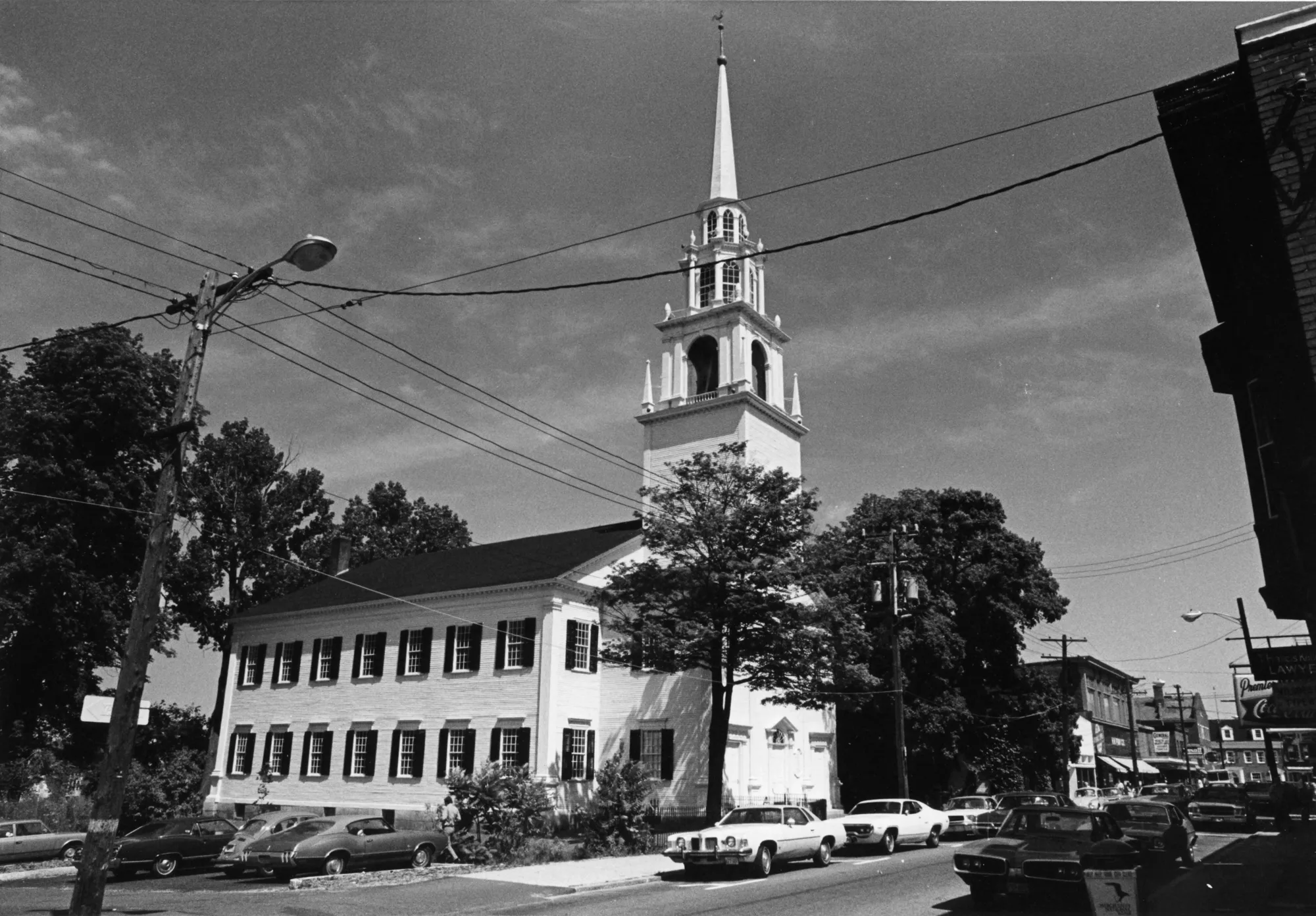
Stop 12 · c. 1801
28–30 Pleasant Street
Church of the First Religious Society (Unitarian)
Photo: Massachusetts Historical Commission, MACRIS inventory
Currier's History of 1906 says the society sold its old meeting house in Market Square, held the last service there on September 27, 1801, took the steeple down the next day, and dedicated this building on Pleasant Street on Thursday, October 1, 1801; tradition gives the design to Timothy Palmer, the bridge builder, though Currier cannot prove it. Thomas Wentworth Higginson was its pastor from 1847 to 1849, and Artemus B. Muzzey from 1857 to November 1864.
This is where the city mourned Lincoln. Currier says that on the Monday after the assassination the city council resolved to drape City Hall in mourning for thirty days and asked for a suspension of business on the day of the funeral. On Wednesday the nineteenth, at noon, “all the bells in the city were tolled, and religious services were held in all the meeting houses,” and at three o'clock a special service arranged by the mayor, George W. Jackman Jr., was held in this meeting house: prayer by the Reverend Randolph Campbell of the Prospect Street church, addresses by the Reverend Samuel J. Spalding and the Reverend Richard H. Richardson, and the benediction by the Reverend Daniel P. Pike. That summer the same building held the homecoming. On July 4, 1865, Currier says, the city government and the soldiers and sailors who had returned from the war were escorted by the Veteran Artillery Association and the City Cadets through the principal streets to this meeting house, where Albert Hale read the Declaration of Independence and George B. Loring gave the address; then everyone went to City Hall, where dinner was laid for seven hundred and fifty, and after the cigars were lit Mayor Jackman welcomed the veterans and Colonel Eben F. Stone and Major Ben: Perley Poore answered toasts to the Army of the Gulf, the Navy and the Army of the Potomac.
Sources: Currier, History of Newburyport, vol. 1 (1906), pp. 255–256, 422–423, 438–439
Back to the start · 150 yardsWalk back down Pleasant Street about 140 yards to State Street and cross it at the corner; the Grand Army building is a few steps down on the far side, where you began.
The soldiers of this walk have their monument elsewhere. Currier's History of 1906 says that in 1896 the Bartlett Post, the Belleville and City Improvement societies and the Woman's Relief Corps formed an association to put up a memorial on Atkinson Common, at the far end of High Street, and that the bronze soldier returning from the war, modelled by Theo Alice Ruggles Kitson and set on a boulder near the entrance, was given to the city on July 4, 1902, after Willard J. Hale had read the Gettysburg address to the crowd. Garrison's statue, “Ould Newbury” says, has stood in Brown Square, off Pleasant Street, since July 4, 1893.
Sources for this walk
The script paraphrases and quotes these works, all of them out of copyright, and names each one as it goes. Page numbers are from the editions linked here. Where the script says “our research for this site,” the facts are from the building page it links to.
- John J. Currier, History of Newburyport, Mass., 1764–1905, vol. 1 (Newburyport: the author, 1906). archive.org/details/historyofnewbury01curr
- John J. Currier, History of Newburyport, Mass., 1764–1905, vol. 2 (Newburyport: the author, 1909). archive.org/details/historyofnewbury04curr
- John J. Currier, “Ould Newbury”: Historical and Biographical Sketches (Boston: Damrell & Upham, 1896). archive.org/details/ouldnewburyhisto00curr
- E. Vale Smith, History of Newburyport; from the Earliest Settlement of the Country to the Present Time (Newburyport, 1854). archive.org/details/historyofnewbury00blake
- Sarah Anna Emery, Reminiscences of a Nonagenarian (Newburyport: William H. Huse, 1879). archive.org/details/reminiscencesofn00emer
- D. Hamilton Hurd, comp., History of Essex County, Massachusetts, vol. 2 (Philadelphia: J. W. Lewis & Co., 1888). archive.org/details/historyofessexco02hurd
- Massachusetts Historical Commission, Massachusetts Cultural Resource Information System (MACRIS), Newburyport inventory forms. mhc-macris.net
- Biff Bouse, oldnbpt.com building pages (own research from deeds, Sanborn maps and newspapers). oldnbpt.com
More walks: State Street and Market Square · Green Street, Brown Square and Pleasant Street · High Street: Down Along and the Ridge · Federal, Spring and Middle Streets · The Water Street Waterfront · Joppa: The Oldest Houses · Joppa: The Fishing Village · Along the River: The North End Shipyards · The Rail Trail: Mills, Ropewalks and Old Hill · Churchyards and Burying Grounds